
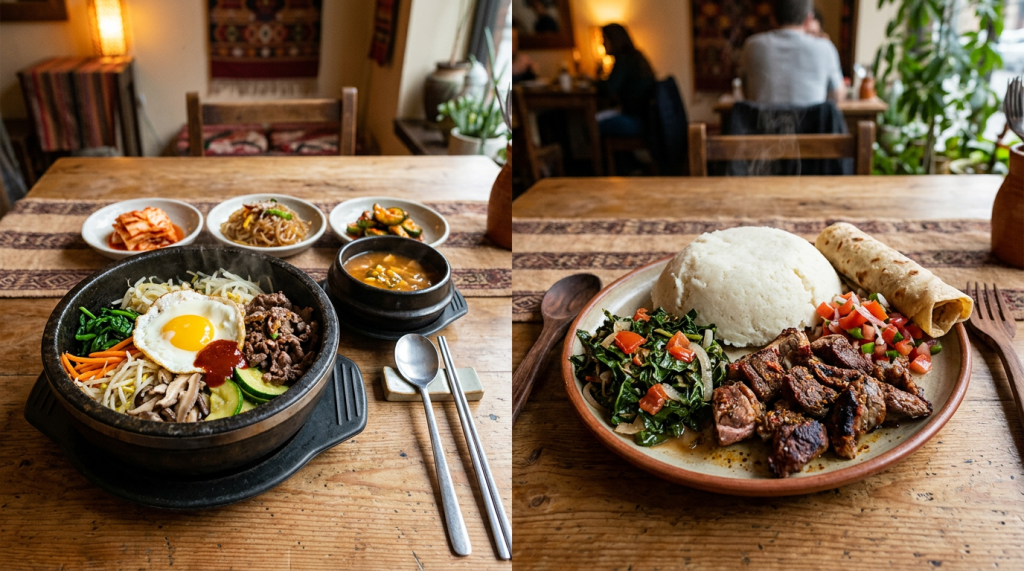
Food is more than nourishment; it is memory, identity, and quiet storytelling. When I think about East Asian and East African cuisine, I don’t just see ingredients or techniques; I see two worlds shaped by land, history, and deeply rooted cultural rhythms.
In much of East Asia, places like South Korea, China, and Japan, food often reflects balance and harmony. Meals are rarely built around a single dominant dish; instead, they unfold as a collection of small, intentional portions. Fermentation plays a central role, from kimchi to soy-based sauces, preserving not just food but tradition. There is a quiet patience in these cuisines; time is an ingredient.
The flavors lean into umami, savory, layered, and sometimes subtly sweet. Even dishes that aren’t meant to be sweet often carry a gentle hint of it, as if to soften the edges. There’s a sense that food is meant to comfort without overwhelming, to sustain both body and mood.
In East Africa, across countries like Kenya, Tanzania, and Uganda, food feels grounded, hearty, and direct. Meals are often centered around a staple: ugali, matoke, rice, or chapati. Around it, flavors build through stews, grilled meats, and vegetables. Fire and warmth are more than cooking methods; they are part of the experience.
Spices are used with intention, but not excess. The goal is not to layer complexity endlessly, but to honor the food’s natural taste. There’s a bold honesty in a plate of nyama choma; what you see is what you taste.
What stands out most is not the difference, but the shared purpose.
Both cuisines are deeply communal. In East Asia, shared dishes placed at the center invite participation. In East Africa, eating from a common serving, whether physically or symbolically, reinforces a sense of belonging. Food, in both spaces, is relational.
Yet, their philosophies diverge in subtle ways. East Asian cuisine often refines cutting, fermenting, balancing, and adjusting. East African cuisine anchors grilling, simmering, sustaining, and satisfying. One leans toward preservation and precision; the other toward immediacy and fullness.
Both are responses to the environment, history, and need.
For me, moving between these two food cultures has been a quiet lesson in adaptability. One teaches patience and nuance; the other teaches boldness and simplicity. Together, they remind me that nourishment is not just about what fills the stomach, but what shapes the soul.
Faithful Steward Chronicles
 FAITHFUL STEWARD CHRONICLES
Leave a comment