
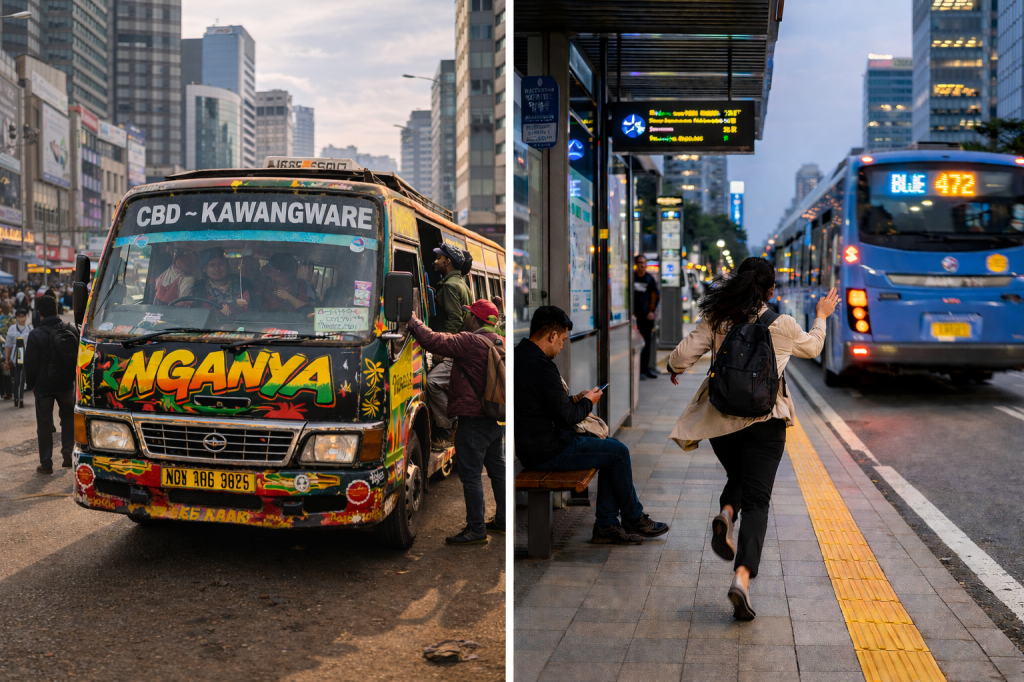
Two rhythms of life. In Nairobi’s CBD, the matatu waits as passengers gather. In Seoul, the bus leaves exactly on time. Between these two moments lies the journey from pole pole to pali pali.
In Africa, wisdom often comes in the form of proverbs.
One of the most familiar is simple but profound:
Haraka haraka haina baraka.
Hurry hurry has no blessing.
It is often followed by another phrase:
Pole pole ndio mwendo.
Slowly, slowly is the way.
These sayings are not just about speed. They reflect a deeper understanding of time and life. Things unfold as they should. People arrive when they arrive. Journeys begin when everyone is ready.
At many bus stages, time had its own rhythm.
You might ask the conductor when the bus would leave.
“Nine o’clock,” he would say with confidence.
But nine o’clock would come and pass. Someone was still arriving with a sack of maize. Another passenger had just appeared carrying a banana in a basket. A mother stepped in with a child tied securely on her back.
The bus did not leave when the clock insisted.
It left when the moment felt complete.
And if anyone grew impatient, someone nearby might simply smile and say:
There is no hurry in Africa.
Years later, I found myself living in Seoul.
Here, the rhythm of life is very different.
There is a phrase that captures it perfectly:
Pali Pali.
Quickly. Quickly. Faster faster
Everything moves with precision and urgency. Trains arrive exactly on time. Buses depart exactly when scheduled. The city moves like a well-tuned machine.
One day, I was walking toward the bus stop.
As I approached, the bus I intended to take pulled away just as I arrived.
Instead of frustration, I simply smiled and sat down on the bench. Another bus would come in ten or fifteen minutes.
As I waited, I noticed something happening on the opposite side of the road.
A woman was running toward a bus that was about to leave.
She ran with urgency, almost desperation, hoping to reach the door before it closed. She waved frantically …
But she didn’t make it.
The bus pulled away.
For a moment, she stood still, catching her breath.
And in that quiet moment, something struck me.
Two worlds.
In East Africa, the bus might have waited a little longer.
In Seoul, the bus leaves when it is supposed to leave.
The system moves, and everyone must move with it.
Sitting there at that bus stop, I realized that time itself carries different meanings in different places. Diaspora life.
One culture moves pole pole.
Another moves pali pali.
Yet somewhere within me, the old proverb still whispers its gentle wisdom:
Haraka haraka haina baraka.
Perhaps the art of living is learning when to move quickly…
and when to move slowly.
Faithful Steward,
Reflections on Faith, life, Food, and culture
 FAITHFUL STEWARD CHRONICLES
Leave a comment